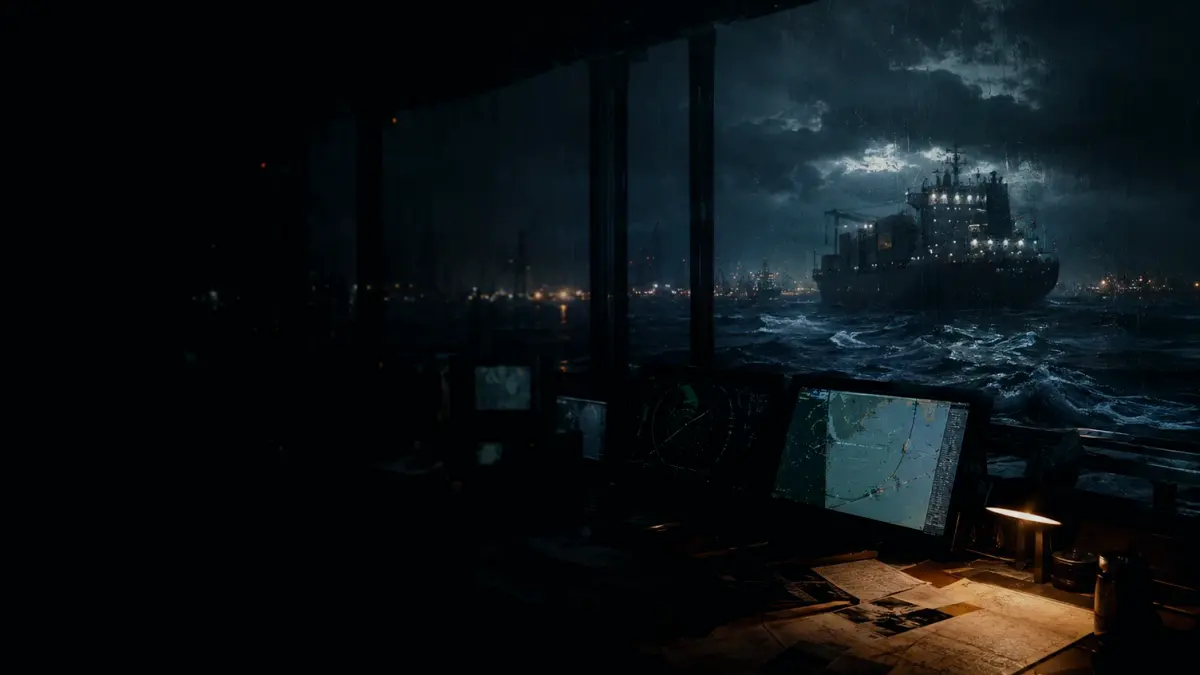
Marine radar is a navigation aid that displays echoes, allowing their range and bearing to be observed over time. Those observations support navigation and the assessment of possible collision risk. The display supplies measured returns rather than an automatic identity or legal conclusion about a contact, so a watchkeeper must interpret what appears as the surrounding picture changes.
A succession of observations can show how a contact is moving relative to the observing vessel. This developing picture is more useful than treating one return as a complete account of the target. Radar can add information that is difficult to obtain in the same form elsewhere, but the watchkeeper remains responsible for identifying objects and hazards early and for deciding what the measurements mean.
What ARPA contributes after acquisition
Automatic Radar Plotting Aid, or ARPA, supports manual or automatic target acquisition. Once acquired, a target can be tracked and relevant calculated target information displayed. Acquisition places the selected return into the tracking process; it is not automatic recognition of what produced the echo. The displayed calculations remain information about the developing track.
ARPA also needs time to calculate accurate data. Its information develops after acquisition rather than appearing instantly as a settled result. The calculation does not remove the need for an alert watchkeeper, who still has to identify objects and hazards early. ARPA assists with tracking and presentation, while responsibility for reading the target information remains with the person keeping the watch.
Limits in the picture and information outside it
Sea clutter and rain clutter can obscure or complicate returns. False echoes, the aspect of a target, beam width, blind arcs and shadow sectors can also limit what appears and how confidently it can be read. These limits arise from the displayed returns, the target and areas where the radar view is restricted. Their practical effect is uncertainty about what the radar picture contains or omits.
Radar, AIS, visual lookout and charts provide different information and must be interpreted together rather than treated as interchangeable. Comparing them lets a watchkeeper test a radar interpretation against information obtained in another way. Agreement can support the developing picture, while a difference keeps the assessment open and directs attention to the known limits. The combined view informs navigation without asking any one source to answer every question.